
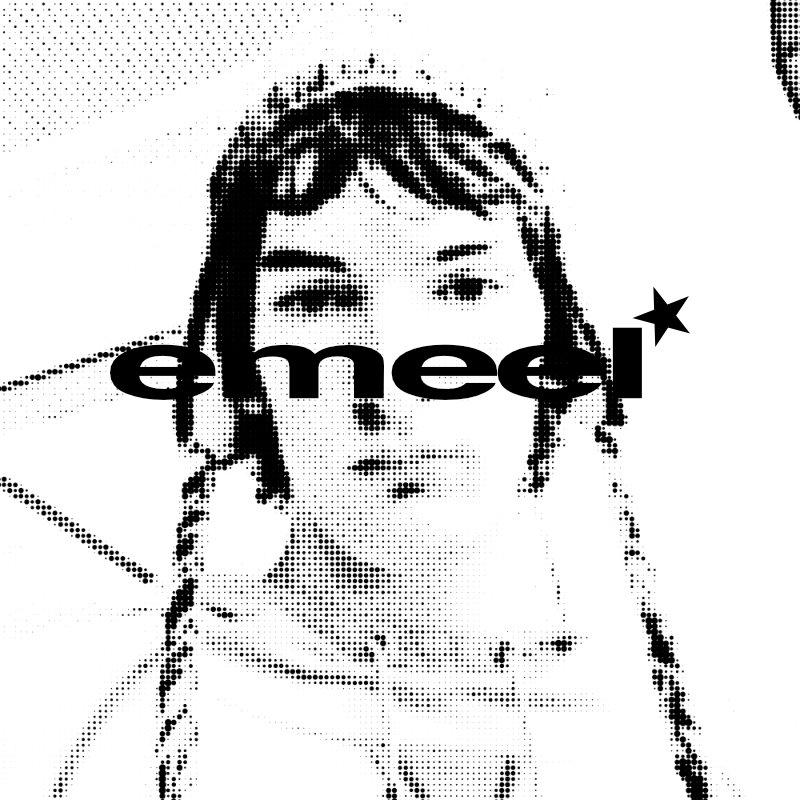
i hate change so when i listen to music ill more often than not replay the same song over and over and over. because of this, there are 20 or so songs that i actually know. emeel’s pixel friend is one such song.
his music is ethereal, cute, and addictive, like some designer drug, “pixie dust” or something. when he responded to my dm to interview him, i was pretty geeked. the conversation focuses on emeel’s lore: how he started making music in spite of rejection, his influences, and his latest album soft spoken. we also discuss creation and perfectionism, how best not to hold back, biking and being dutch. he’s a very lucid and eloquent person, and I hope I did that justice in the interview.
emeel’s most recent release, Castle Life/Club Wish, is out now.
loser magazine: I haven’t eaten all day and I’m low-key hypoglycemic right now. There’s a chance I pass out in the middle of the interview.
emeel: Low-key same. Bit hungover too.
lm: How was the Bby Eco release show?
e: Super cute. Everyone from the Amsterdam scene: Seedlink, Klub Krai, and people from Gerrit Rietveld academy was there. I stayed out way too late. I’m in this weird emotional state where I’m super drained but also weirdly emotional because I had so much fun.
lm: Is Rietveld (I pronounced this perfectly) academy where you go to school?
e: Yup. I’m in my first year.
lm: What do you study?
e: First years don’t choose a department. Rietveld is different from other art schools, at least in the Netherlands, because they don’t want students to specialize before they work across a breadth of different media. The school’s philosophy is very multidisciplinary.
lm: Didn’t you go to graphic design school before art school?
e: More like an applied web design program, a combination of graphic design, UX design, and coding. It was really applied, you were learning these things just to get a job. Everyone was so npc. I got nothing from being there.
lm: At my job I feel like an npc. Wool sweater wearing, 401k core; can’t shut up about stocks. I thought I’d be immune to it, but I’m deep in npc life.
e: It’s kind of scary. So glad I didn’t go down that road.
lm: When did you start making music?
e: I’ve been making music since 13 or 14. My brother got me into it. His room was right next to mine, and our walls were really thin, so I could listen to whatever he was working on. His music would come from the walls, even while I was trying to sleep.
lm: Nightmare situation.
e: Strangely, I really enjoyed it. I don’t think I was consciously thinking about “making music”, I just wanted to do what he did. After my brother cracked Ableton for me, I’d run straight to my computer after school to make beats — lots of different shit, mostly trap, but I’d make hip hop and EDM too. I’d hear a song I liked somewhere and try and make it. That period was nice, it taught me a lot about different genres.
lm: There’s something special in naivety. You’re not trying so hard. Whatever you make is so natural. You almost get worse as soon as you want something. Creating becomes this grotesque birthing process where you wriggle and writhe against your lack of skill to bring out the beauty within you.
e: True. I also like that at the beginning you’re unaware of stuff. I’ve been making music for so long that I feel I understand too much, and I can silo myself into genres too neatly. It’s what I like about my earlier project, suffix, you can hear my naivety in each song.
lm: Interesting you say that. I feel like your music isn’t a neat silo, more of a synthesis of genre. You like hip-hop drums but your synths are more EDM. They shimmer. Your music has a real light to it. It’s very, to borrow your term, cute.
Your brother is Ity, the founder of Seedlink, right?
e: Lore drop. Yeah.
lm: Would you talk about his influence on you?
e: As a younger sibling, I wanted to do whatever he was doing. He’d bring me to hang out with his friends, and we’d all go to events and stuff. They were all huge music nerds, so my first experiences with underground music were very curated. For example, one of the first times I went out with them was to see Oli XL. Seedlink was also a nice mode of discovering underground music on Soundcloud. Bit by bit I made it my own.
lm: It’s like he gave you a palette of colors which you learned to make your own images from.
e: Exactly.
lm: What was the first song you made that you felt like you were coming into your own?
e: The first one that pops into my head is Fly Fox Tail. At first I only had the first half. It’s pretty, but a little boring. I couldn’t figure out what to do. Biking home one day, I was listening to A. G. Cook. His songs have these big moments where it changes drastically, morphing from beautiful to powerful. When I got home I wrote this hype arpeggiated part, which is the second half of the song. That song was quite a breakthrough for me. Now I really lean into these big moments.
lm: When you produce, do you do it incrementally or as much as possible in one go?
e: First I’ll spend a few days on a sketch, then I’ll get stuck in a blob of mixing for months, which sucks. Usually at that point, I’ll send it to other people for feedback. If no one tells me to stop, I’d never stop tinkering on a song.
lm: How about the other media you make? How did that come about?
e: I started doing other creative media later. Looking back at my camera roll I can see some stuff: edited pictures, that sort of thing. Nothing serious. During my gap year after quitting web design, when I wanted to apply to art school, I thought I should take visual and design arts more seriously.
lm: What made you want to apply to web design in the first place?
e: It was kind of random actually. I never had a big, big passion for it. I got rejected from music school and web design made sense; I work a lot with my computer, and I could see myself doing it because it was somewhat creative, blah blah blah. I was eighteen and had no clue what I wanted to do.
lm: Why did you get rejected?
e: They said I didn’t have a clear vision of what I wanted. I was more fluid with it. I was interested in trying stuff out, and seeing where it went. I guess they really wanted people that had a rigid npc vision of EDM or something.
lm: That’s sad. More and more it seems like the world demands young people to have a clear direction by 18. It’s a crazy ask. Eighteen is not enough time to have the experiences that age grants you, the ones that inform you of what you really want.
e: Yeah, my new school is more about getting those experiences, which I like. In retrospect, it was for the best I didn’t get into music school. It would have taken away the joy of making music; they treat it more like a job. Even if I went, I’d somehow find a way to get into the same communities I’m in now.
lm: How did you keep going after being rejected from music school?
e: I was sad for a bit, but overall it didn’t affect me too much. It made me realize I didn’t want to do music professionally, instead I wanted to focus on art broadly. I liked the idea of going to an art school because it felt like it would be a good place to meet like-minded/alternative people. It’s a really great place to access people and the resources to find yourself.
lm: I appreciate your verve. You’re so compelled to create without knowing what direction you’re headed in. I think that whimsy of being led somewhere you don’t know comes through in the music.
e: I very much feel like I’m trying to go somewhere but I’m unsure where. It’s good, it makes getting there so much more interesting than if I had a defined idea of what I wanted. It’s interesting how things change the more you do them, as long as you are curious.
lm: In a lot of ways I’m the opposite. For better or worse, I almost know exactly what I want. Often I’m filtered by my own ambition. Sometimes it’s good because I easily set a course and a direction; but I get so frustrated when I deviate. I wish I didn’t beat myself up so much, so I’m trying to be more loose. loser is supposed to help me be less autistic.
e: It’s a balance for me. I’m not only wandering, I’m purposeful with music and my vision. At the same time, I want to keep paths open, not cement myself as a specific thing, and see where I can go. That’s why I don’t want to do music as a job. I want to make connections between everything I’m doing, without the pressure.
lm: That’s the best kind of creating, for the sake of it. I really like when someone doesn’t cross the line from using their voice to using a put on “artistic” voice to like sell shit or something, like when you read a book and the words on the page are so clearly from the writer’s spirit.
e: I think you can also really feel when someone is nerdy about very specific things, when someone has done their years.
lm: making shit is low key loser. you really have to be impassioned and sensitive. it’s gross, sometimes humiliating. when it all comes together, and you finally get your roses, it’s so nice. would you say you’re maturing into a sound that is ‘yours’?
e: I think a consistent voice that’s mine is emerging, but I can feel it changing with the stuff I’m making now.
lm: Let’s frame that with your most recent album, Soft Spoken. Pixel Friend was the first song of yours that I heard, and what I associate most with your ‘voice’. did that come about early on?
e: Xim and Chu Chu were the start of the whole project — those two tracks were like the seeds of it. Soft Spoken was kind of terrible in the sense that I spent way too long on it. I went through like three different EPs fully, with completely different songs each time, only one original track survived the whole thing. It was even called something different at first. Like, I could’ve dropped three EPs in that time. But I think in the end, what needs to happen, happens.
lm: the ‘chu chu’ vocal line lives rent free in my head
e: Chu Chu came to me when I was on truffles haha. it was a totally different song when I started it.
lm: How do you get your vocals baby mode?
e: It’s this plugin called manipulator. Basically I pitch it up 12 or so semitones, and I’ll change the formants which creates very babyish voice. I don’t technically know how it works but it sounds nice.
lm: Chu Chu, Xim, and Pixel Friend sound nothing like what’s on Suffix. what changed between then and soft spoken?
e: Compared to suffix, soft spoken has a lot more directness in it, a lot more contrast. When I was producing Soft Spoken I really loved going out. The music at the clubs and the queer-friendly events really inspired the production.
lm: What were you listening to?
e: Doss, Himeria, Planet 99, Hannah Diamond, stuff like that. A ton of A.G. Cook. Cutesy stuff.
lm: Well you kind of found your footing too, right? Because looking at your new singles, you seem to be building from the same milieu as Soft Spoken.
e: Well it’s interesting. When I made Pixel Friend, Scratch, and Q2world I immediately thought “no, these can never be emeel, they’re too clubby, too direct.” I was really attached to the more video gamey, blippy-bloopy sound. For Soft Spoken I had to break out of that. Especially for Pixel Friend. I wasn’t even making it for a project, I just made it and disregarded it for a long time. I had this one random session where I went back to it and gradually realized there was really something in it. It still has the video gamey melodic elements but combined with something harsher, more substantial.
lm: Funny, since pixel friend was my entry point to ‘emeel’, it’s my reference point. Everything else is the ‘other stuff’.
e: Yeah, I had to grow into it, reach some kind of acceptance that I have affinities towards these sounds, you know? More pop inspired I guess. I think that’s actually what made the project really strong. The contrast of cute stuff with harsher more direct sounds, distorted basses and stuff. And that’s something I’m now very consciously leaning into, trying to make that contrast bigger, with more poppy progressions.
lm: It’s grounded in something more visceral, more bodily. How did you write the lyrics for pixel friend?
e: I don’t know. I feel like some points of it don’t even have lyrics. I’m just like mumbling.
lm: Low key I don’t know a fucking word you’re saying on that song haha.
e: Yeah, I mean, it’s definitely not the strongest element of my music. There are moments with actual lyrics, but a lot of it is just fully mumble. I never really wrote lyrics for it, I kind of started singing more as an instrument, just mumbling melodies and then attaching words along the way. That’s honestly one of my weak points, I’d love to get better at vocals, because right now they’re just a bit… random.
lm: They’re affected really well, though. It’s not something you probably think about, but it sounds like there’s something you’re yearning badly for.
e: Yeah. That’s very true. Strong feelings without like saying them.
lm: Actually, why do you sing in English?
e: Hmm. I really enjoy the international-ness of it. If I imagine doing it in Dutch, it seems strange. I don’t even know why, but I kind of like not being perceived as Dutch. It’s kind of stupid, cause it’s fine to be Dutch, you know?
lm: Do you find when you’re writing in English you’re constructing things differently than you would in Dutch?
e: I have a pretty good grasp of English. Most of my friends are international, and more than half of them don’t speak Dutch, so I’m always speaking English. When I was younger, I was obsessed with not having an accent because I thought it was cringe or something. I really liked the idea of being stealthy with it; that people can’t perceive me as Dutch. The music I make is ethereal, and it works better if it’s placeless. I want to create this dreamy space which doesn’t make sense to bind to a place on earth.
lm: Well, does your city (Amsterdam) influence any part in your music?
e: Yeah, the city has a real lightness that’s reflected in my music. Amsterdam is very small, so everyone in the underground/art community knows each other. There’s always some music or exhibition going on. Everyone is bike mode; even if you’re fucked up and 45 minutes from home, you’re biking. Biking is a really small and cute thing. In the summer everyone is on their terraces or on a picnic. We know how to enjoy ourselves – it’s nice.
lm: what’s the balance between your ‘dutchness’ and ‘internationalness’
e: That’s a hard one, because I’m sure Seedlink and all those people were super influential for me, but I wouldn’t say that I have a ‘Dutch sound’. The music exists on Soundcloud and the internet where people in like Japan listen to it. It is local too, me and my friends are all listening to each other’s music. We’re really organized, so people are asking me to do shows, so it is local like that.
lm: do you perform often?
e: Only recently. When I started it really was just this online thing. I never had the intention to perform. Now I DJ and stuff.
lm: Do you sing at your shows?
e: One time.
lm: How’d it go?
e: Good, but it was terrifying, not gonna lie. I was nervous the whole week, so I prepared a ton. I set it up so I could use my auto tune and just sing adlibs, rapper style.
lm: Aura farming.
e: Yeah. Personally, I really enjoy it. I don’t really care if someone can sing or not. It’s about the energy at the show. Not being able to sing is something our parents would be furious about. They don’t get it.
lm: I don’t know, I feel there are two sides to it. What I think is cool about shows is the vulnerability of it, like when you have to either do the thing or mess up. I saw Eurohead last week and he fucked up a transition. By doing that, he got the crowd to respond to him, cheer him back on. I love moments like that, when accidents happen you see the hand of the creator. It’s cool to me. By telling them to keep going you’re essentially reinforcing what they create, which is the cool part about contemporary stuff in the first place. What you support affects what gets made, I don’t know.
e: That’s interesting.
lm: Anything coming up next?
e: My friends from Klub Krai are organizing a super cute sleepover event. It’ll be in a warehouse with a bunch of studios in it – honestly one of my favorite places to go out. Everyone’s going to be in pajamas; there’s going to be a big mattress in the middle. I’m gonna perform.
lm: New music?
e: A lot actually. I’m in a bit of a moment where I’m trying to figure out how I want to release stuff. Cause my last two albums I put onto Seedlink, which is backwards from how people usually do it. Usually, people put a bunch of demos on Soundcloud and then maybe do something with a label. I want to find a better balance of dropping stuff and reaching out to other labels and stuff. The label route is a bit frustrating because you’re always waiting for other people that are always busy. I’m torn – I like the idea of doing everything myself, but a label is more established. I want to release all this new music, but I don’t want to oversaturate.
lm: I appreciate that your page is pretty sparse. It’s cool when you can see the progression from album to album, rather than a gradient of a million singles.
e: It’s hard. Maybe I’ll drop some random songs. Before I was too uptight, it was too much. It feels stupid to wait for months and months, when I can make it simple for myself and just release the music on my own. I need to find a balance.
lm: throughout the interview you’ve described things as cute. Off the top of your head what are some things you find cute?
e: Hm. Weird teeth, RGB light strips, going to a supermarket with friends, laptop selfies, sidechaining, grey, furries, the letter x, silver tape, blurry pictures. 
 LOSER Magazine